
In the past, preparing a single contract would take hours of careful drafting, editing, and legal review. Today, artificial intelligence can generate the same document in a matter of seconds. This change has transformed how entities, freelancers, and legal professionals draft contracts, making the process faster, easier, and more accessible than ever before.
Businesses and individuals can generate contracts within minutes using AI-powered tools such as ChatGPT and specialized legal platforms like Robin AI. These systems use advanced language models trained on large amounts of legal and commercial information to draft agreements, suggest appropriate clauses, and adjust documents to fit specific situations. As a result, tasks that once required many hours of a lawyer’s time can now be completed automatically.
What Are AI-Generated Contracts?
AI-generated contracts are legal agreements drafted, reviewed, or customized using artificial intelligence rather than being written entirely by a human lawyer. These contracts are created when a user provides instructions, prompts, or business details to an AI system, which then produces a structured legal document based on patterns learned from existing legal texts. Using this, individuals and businesses can generate documents such as employment agreements, service contracts, or non-disclosure agreements within minutes, even without advanced legal knowledge.
Essential Elements of a Valid Contract
Before examining whether AI-generated agreements are legally enforceable, it is important to understand the basic principles that render any contract valid under the law. A contract is a legally binding agreement between two or more parties that creates enforceable rights and obligations. For a contract to be valid, it has the following elements, as per Sirion (2026)
a) Offer
An offer is a clear and definite proposal made by one party to another, expressing a willingness to enter into a contract on specific terms. The offer must be clear and complete, including important details such as the price, subject matter, and each party’s responsibilities. Without a clear offer, there is no proper basis for forming a contract.
b) Acceptance
Acceptance occurs when the other party agrees to the terms of the offer exactly as presented. Agreements must be communicated to the person who made the offer and should not include any new terms. In modern transactions, acceptance can take different forms, such as signing a document, confirming electronically, or acting in a way that clearly shows agreement.
c) Consideration
Consideration refers to what each party gives or promises to give in exchange under the contract. This could be money, goods, services, or even a promise to do or not do something. This exchange of value is what makes a contract legally binding, as it separates it from a gift or a voluntary promise. Without consideration, most agreements cannot be enforced by law.
d) Capacity
Capacity refers to a person or organization’s legal ability to enter into a contract. The parties must be of legal age, mentally capable, and acting freely without pressure. The law provides that “contracts involving minors, individuals under the influence of substances, or those who lack mental capacity may be considered invalid and can be cancelled depending on the situation.”
e) Intention to Create Legal Relations
For a contract to be valid, both parties must intend for their agreement to have legal consequences. This means they must expect that the agreement will be enforceable by law. This requirement helps distinguish formal agreements from casual or social arrangements, such as promises between friends or family. In business situations, courts generally assume that this intention exists unless there is evidence to suggest otherwise.
f) Legality
A contract must be based on a lawful purpose. Agreements that involve illegal activities or violate public policy cannot be enforced by the courts, even if all other elements are present. This ensures that the legal system does not support or give effect to unlawful actions.
What is an AI Contract Generator?
An AI contract generator is a tool that uses natural language processing and machine learning to turn a simple prompt into a fully structured legal agreement, complete with the correct clauses and formatting. Unlike traditional templates that require users to fill in fixed sections, these AI tools draft the document from scratch, adapting each part to the parties involved, the scope of the agreement, and the governing law, making the contract more flexible and designed to the specific needs.
Read Also: The Rise of AI-Powered Marketing Tools
How the AI Contract Generator Works
The AI contract generator follows a couple of procedures to generate perfect, error-free contracts from your prompt. The procedures are illustrated below.
a) Gathering Information
AI contract generators begin by collecting essential details from users, usually through guided questions that ensure all relevant information is captured for creating a complete contract. At this stage, the users provide details such as:
- The key parties involved in the contract
- The terms and conditions of the contract
- Scope and objective
- Deadlines involved in the agreement
These inputs form the foundation of the contract, allowing the AI to produce a document tailored to the user’s needs. The user is advised to ensure that they provide accurate details, as incorrect information will result in errors in the contract.
An AI contract generator provides you with a variety of templates that determine the structure of the information that you will provide. Choosing the right contract template is an important step, as it determines the information provided. Using the correct template also helps ensure the draft aligns with industry standards and relevant legal frameworks. For instance, if you pick the wrong one, say, a service agreement instead of a non-disclosure agreement, the draft may miss critical clauses or include irrelevant ones, so you must choose the correct one based on the type of contract to be created.
b) Drafting and Customization
Once the information is gathered, the AI analyzes the input and aligns it with the chosen template to generate an accurate draft of the contract. For the AI to ensure that all required information is included in the contract, it analyzes the user’s input data and aligns the contract with the preset contract templates. Additionally, artificial intelligence identifies the key terms and conditions required in the contract. It dynamically adjusts the language and structure to fit the specific context of the contract.
An AI contract generator also provides clause suggestions, which help tailor provisions to industry standards or business needs, thereby reducing ambiguity and legal risk. Customization allows users to adapt drafts to reflect their operational realities and strategic objectives, ensuring contracts are both legally sound and aligned with business needs.
c) Review and Compliance Checks
In any contract, Compliance is essential. AI tools conduct automated compliance checks by comparing the draft against legal standards and industry norms. The AI contract generators use advanced technologies such as natural language processing (NLP) and machine learning to identify potential issues, including missing clauses and regulatory gaps. Additionally, human intervention is needed at this point to correct any errors in the contract’s intentions and context. For example, reviewing NDAs requires understanding the specific strategies and clauses to ensure the agreement effectively protects all parties.
d) Collaboration and Finalization
AI contract generators also support team collaboration. They have features that allow multiple users to work on the same document in real time and to efficiently incorporate feedback from different stakeholders, ensuring that all the adjustments needed in the contract are made as per the suggestions of different stakeholders in the business.
After drafting the contract, AI contract generators offer finalization tools, such as electronic signature capabilities. This tool enhances the signing process, saves time, and maintains a secure digital record. The finalization tools’ features ensure that contracts are comprehensive, legally compliant, and ready for execution without unnecessary delays.
How Businesses Are Using AI for Contracts
Businesses have adopted AI to draft their contracts and manage legal tasks. These tools will help you and your business reduce the time and effort needed to draft, review, and manage agreements by automating routine contract creation processes. Below are some of the agreements you can easily use AI contract generators to generate for you.
- Non-Disclosure Agreements (NDAs) – AI tools can quickly generate standard NDAs for early-stage business discussions. These agreements help protect sensitive information while saving time on manual drafting.
- Freelancer Agreements – Businesses use AI to create contracts for freelancers that include payment terms and the scope of work. This ensures clarity and reduces the risk of misunderstandings.
- Template Agreements – AI can produce basic templates for supplier or client contracts that can be customized later. This provides a consistent starting point for different types of agreements.
- Legal Research – AI helps summarize case law and quickly identify relevant legal rules. However, the results still need human review to ensure accuracy and proper interpretation.
Top AI Contract Tools for Businesses in 2026
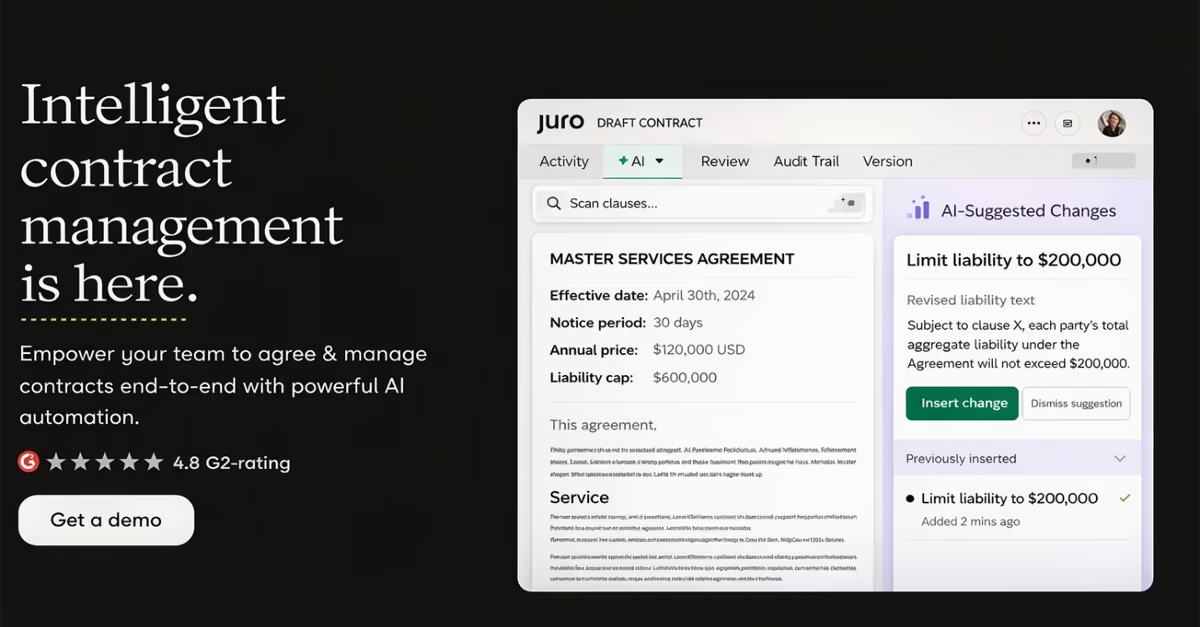
AI-powered contract tools have become essential for modern organizations. These platforms enable businesses to draft, review, and manage agreements faster, more accurately, and more efficiently. A study by Marijn (2025) highlights the following common AI contract generator tools used in businesses.
- Juro –Generates contracts from prompts or smart forms and allows teams to collaborate, edit, and track contract data in a browser-based workspace without relying on traditional document files.
- Contractbook – Drafts agreements from dynamic templates, stores them in a centralized cloud repository, and provides automated reminders and searchable insights for contract management.
- Ironclad – Uses AI to identify key clauses, insert approved fallback language, and flag unusual terms, helping legal teams maintain control while business users generate contracts through automated workflows.
- Genie AI – Offers a large open-source library of legal clauses and uses AI to suggest alternative wording, helping users create customized contracts that align with market standards.
- Luminance – Uses advanced machine learning to draft, review, and even auto-negotiate contracts, identifying risks and adapting its recommendations based on user edits and negotiation patterns.
- Robin AI – Offers a Word add-in that drafts and reviews contracts using AI suggestions, helping legal teams accelerate negotiations and reduce manual review time.
- Chamelio – Converts plain-language deal descriptions into structured legal contracts and provides interactive explanations of clauses to help non-lawyers understand their obligations.
- MyDock365 – Integrates AI contract generation into the Microsoft 365 ecosystem, allowing organizations to create, route, sign, and track agreements within familiar productivity tools.
- DocuSign Intelligent Agreement Management (IAM) – Integrates AI-powered drafting, risk detection, and obligation tracking directly into its e-signature platform, enabling organizations to manage the entire contract lifecycle in one interface.
How AI Contract Generators Help Businesses
AI-generated contracts provide small businesses with an efficient way to simplify legal processes, reduce costs, and maintain consistency, even without having an in-house legal team. A study by Kirk (2025) highlights the benefits a business gets by using AI contract generators to draft contracts.
a) Time Savings
AI contract generators can save business owners considerable time. Studies suggest that AI tools can save users an average of several hours each week, and contract drafting is a clear example of this benefit. Instead of writing every clause manually or consulting a lawyer for basic agreements, users can provide prompts to AI tools like Juro and receive a complete contract draft within minutes. After that, only minor edits and review are typically required, allowing business owners to focus on other important tasks.
b) Cost Savings
Using AI for contract creation can also significantly lower expenses. Simple agreements can be generated without hiring a costly legal professional, and even for more complex contracts, AI can create an initial draft that a lawyer only needs to review. This reduces billable hours, helping small businesses save money while still ensuring their contracts meet legal requirements.
c) Consistency
Maintaining consistency across multiple contracts can be difficult, especially for a growing business that handles many clients and employees. AI contract tools help standardize language, clauses, and formatting by allowing users to save and reuse templates. Once a well-structured agreement—such as an employment contract—is created, it can serve as a model for future documents, ensuring uniformity and reducing the risk of errors or missing information.
Risks and Limitations of AI-Generated Contracts
Legal experts have increasingly warned businesses against relying entirely on artificial intelligence to prepare legally binding agreements. Although AI tools can produce contracts quickly, they do not replace professional legal judgment, and their limitations can expose users to serious risks. The following are the risks you must understand as you use AI-generated contracts in your business’s contracts.
a) Lack of Legal Expertise
AI systems generate contract language based on data patterns rather than true legal reasoning. As a result, they may fail to properly interpret complex legal issues or anticipate potential disputes like a trained lawyer would.
b) Fabricated Legal Information
AI tools can sometimes produce incorrect legal references or even create non-existent laws or cases. This happens because they generate text based on probabilities rather than verified facts, which can mislead users. This may create legal consequences for your business.
c) The Ability to Customize Contracts to Specific Situations
Most AI-generated contracts rely on general templates that may not fully match unique business needs. This can leave important areas, such as liability, intellectual property, and regulatory requirements, inadequately addressed.
d) Data Privacy Risks
Using AI tools often requires entering sensitive business or personal information into external systems. This creates risks related to data security, as there may be breaches or unauthorized access to this data if strong cybersecurity measures are not put in place.
e) Failure to Reflect Current Laws and Regulatory Requirements
The law keeps on changing. The AI systems are trained on existing and historical data, which they use to draft contracts. This data may not always reflect current legal matters, resulting in contracts that do not always include the latest legal updates. As a result, contracts may not comply with current laws or specific regulations in certain jurisdictions.
How to Use AI in Drafting Contracts Without Legal Risks
Using an AI contract generator only to draft your contracts or business contracts may pose serious legal risks due to the factors already discussed above. The following measures should be put in place to avoid the above risks.
- Draft with Human Oversight – Your businesses should not rely entirely on AI-generated contracts without reviewing them. A qualified person should check each document to ensure it reflects the parties’ intentions and complies with the law, and keeping records of prompts and edits can help prove how the contract was created if needed.
- Include AI-Related Clauses in Contracts – to reduce the risk of disputes, contracts should clearly state whether AI tools were used in drafting. Including clauses on liability, disclaimers, and indemnity helps assign responsibility in the event errors are discovered later.
- Train Staff on Electronic Evidence and Compliance – Your organization should train employees on how electronic records are treated under the law. Understanding legal requirements helps ensure proper documentation and reduces the risk of mistakes that could weaken a case.
- Seek Pre-Litigation Legal Advice – Before starting or responding to a dispute involving AI-generated contracts, it is important to consult a legal professional. Early advice can help assess the strength of the case, ensure compliance with legal rules, and explore alternative ways to resolve the issue without going to court.
Are AI-Generated Contracts Enforceable?
AI-generated contracts can be legally enforceable because contract law focuses on the content of the agreement rather than on how it was created. As long as a contract includes the essential elements of a valid agreement, such as offer, acceptance, consideration, and intention to create legal relations, it can be legally binding even if it was generated using artificial intelligence, as per the study by Kevin (2025). Legal experts generally agree that courts do not require contracts to be written by humans; what matters is whether the document clearly reflects a genuine agreement between the parties. In the same way, modern legal frameworks already recognize contracts formed through electronic systems, meaning agreements created or assisted by software are not automatically invalid simply because AI was involved.
This position is supported by existing laws such as the Kenya Information and Communications Act, which states that a contract cannot be denied legal validity simply because it was formed through electronic communication or automated systems. Sections 83J and 83L further clarify that electronic records and actions carried out by an information system on behalf of a person are legally attributed to that person. In addition, the Evidence Act allows electronic records to be used as evidence in court, provided they are properly verified. Together, these legal provisions show that, in Kenya, AI-generated contracts can generally be enforced provided they meet traditional contract requirements and comply with relevant legal and evidentiary rules.
Read Also: Understanding AI Agents: The Digital Minds Behind Modern Technology
Conclusion
AI-generated contracts are increasingly becoming a practical solution for businesses, freelancers, and legal professionals. You can easily draft your contracts in minutes using AI-generated tools like Juro, Contractbook, Genie AI, Ironclad, Robin AI, and Luminance. While using this tools to generates your contracts remember to revise them to correct the mistakes the artificial intelligent may make like failure to reflect the current laws, fabricated legal information, AI may lack true legal reasoning while drafting this contracts, and some important parts may not be involved in the contract especially when AI uses templates that may not align with objectives of your contact. For this reason, businesses and individuals should use AI as a support tool rather than a replacement for legal expertise, ensuring that all AI-generated contracts are carefully reviewed, well-documented, and aligned with current legal standards before use in transactions or legal proceedings.