Every business must decide how to finance its goals and future growth. The choice between borrowing money and giving up part of ownership can influence the company’s direction for many years. Capital structure is the mix of debt and equity a business uses to fund its operations and growth. Whether a business relies more on debt or equity financing directly affects its risk, potential profitability, and long-term stability.
Capital structure decisions are all about finding the right balance between debt and equity to finance business operations at the lowest possible risk. Businesses that use debt financing can raise money without giving up ownership, but it comes with fixed commitments, such as interest payments and principal repayments. On the other hand, Equity financing removes the pressure of regular loan payments, but it requires owners to share control and future profits with investors. The main challenge for business owners is determining the optimal mix of debt and equity.
Selecting the right debt-to-equity mix is a strategic decision that shapes a company’s ability to grow, remain stable during economic downturns, and attract investor confidence. A poorly planned capital structure can reduce financial flexibility and increase risk exposure. In contrast, a carefully designed structure can lower overall financing costs and support sustainable growth.
Understanding Capital Structure
A study by Lauren (2025) defines capital structure as the specific combination of debt and equity that a business uses to finance its assets and everyday operations. It usually answers a key question, “Where do the funds that are used to finance business operations, expand, purchase equipment, or enter new markets come from?” The business can borrow (debt finance), raise funds from owners or investors (equity finance), or use a mix of both. The way these funding sources are combined forms the company’s capital structure.
Businesses are financed through different capital structures, which can be classified as follows:
- Equity-Based Capital Structure – In this type of capital structure, the business is financedprimarily with funds from owners or shareholders raised through the issue of ordinary shares.
- Debt-Based Capital Structure – A business is financed by capital raised through borrowing. The business acquires these funds throughloans and bonds with fixed interest and principal repayments.
- Hybrid Capital Structure – this capital structurecombines both debt and equity to balance risk, return, and control. It utilizes the flexibility of equity and the tax benefits of debt, often using instruments like convertible bonds or preferred shares.
- Structure by Industry – refers to a capital structure that is commonly adopted by businesses within the same Industry. A firm may choose his capital structure to align with its peers, assuming that companies in the same Industry face similar risks and operating conditions. For instance, suppose several commercial banks in Kenya operate with a debt-to-equity ratio of approximately 60:40. These banks face similar risks, such as regulatory requirements and credit default risk. New banks entering the Industry often adopt a similar capital structure. By following this pattern, they align themselves with established industry standards, build investor confidence, and avoid appearing riskier than their competitors.
The Role of Debt in Business Financing
Debt financing is a formal way to raise capital by borrowing from lenders such as banks, credit institutions, or bond investors. The company is legally required to repay the amount borrowed (the principal) plus interest within an agreed period. The loan agreement clearly outlines the interest rate (fixed or variable), repayment schedule, maturity date, and any conditions such as collateral or financial performance requirements. A study by Lightspeed (2025) highlights the following benefits of using debt in your capital structure.
- Retention of Ownership and Control – debt enables owners and shareholders to raise capital without losing ownership, because lenders do not have voting rights, decision-making authority, or the ability to control business activities.
- Interest Tax Shield – while calculating taxable profit for any business, interest payments are treated as a business expense, which is deducted from operating income, thereby reducing the company’s taxable income and lowering the effective cost of borrowing, thereby improving after-tax profits.
- Leverage to Enhance Return on Equity (ROE) – in situations where the business earns a return that is higher than the cost of its debt. Borrowing, in this case, increases returns to shareholders. When used responsibly, financial leverage supports faster growth and raises the value of the business.
- Lower Cost Compared to Equity – Debt is often less costly than equity because lenders take on less risk than shareholders and therefore expect lower returns. In contrast, equity investors usually expect a share of long-term profits, which can become more expensive over time.
- Predictable Repayment Structure-Debt agreements specify clear repayment dates and interest amounts. This structure makes financial planning easier and helps management forecast cash flow more accurately.
Read Also: Navigating Business Financing Options in Kenya
Risks of Debt Financing

Debt financing can support faster growth and improve returns, but it also creates financial risk that must be managed carefully. If borrowing levels are not matched with stable revenues, the company’s ability to handle risk is compromised. The following are the major risks of having debt in your capital structure.
a) Fixed Financial Obligations
Regardless of revenue performance, a business must make payments of interest and principal. During economic downturns, when revenue and profits are low, it becomes difficult for a business to make such payments, thereby straining its finances.
b) Increased Financial Risk
High levels of debt increase the company’s debt-to-equity ratio, which raises financial risk. Excessive borrowing can make earnings more unstable and increase the likelihood of financial difficulties.
c) Cash Flow Pressure
Regular loan repayments reduce the amount of cash available for daily operations. This may limit the company’s ability to reinvest in growth, fund research and development, or pursue new expansion opportunities.
d) Collateral Requirements
Many lenders require assets, such as property, equipment, or inventory to be used as security for the loan. If the company fails to repay, these assets may be seized, disrupting business operations.
e) Restrictive Covenants
Loan agreements often include conditions that limit additional borrowing, dividend payments, or major business decisions. These restrictions can reduce management’s flexibility in running the company.
f) Risk of Default and Insolvency
If a company fails to meet its repayment obligations, it may face default, legal consequences, credit rating downgrades, or even bankruptcy. Because debt holders are paid before shareholders in financial distress, excessive debt can seriously threaten the business’s long-term survival.
The Role of Equity in Business Financing
Equity financing is a method of raising capital by selling ownership shares in a company to investors. Instead of borrowing money that must be repaid, the business issues shares to the investors in exchange for funds. In return, they gain a claim to future profits through dividends. Depending on the type of shares issued, they may also have voting rights, thus having a say on the company’s decisions. It has the following advantages to the business over debt financing.
- No Mandatory Repayment Obligations – Equity financing does not involve fixed interest and principal payments. This reduces financial pressure on a business, especially during economic downturns when profits are low.
- Lower Financial Risk – Because there are no legal repayment commitments, equity reduces the risk of insolvency as compared to heavy borrowing. For instance, if a business loses, shareholders absorb it rather than the business being pushed into liquidation.
- Improved Cash Flow Flexibility – In equity financing, there are noregular principal and interest payments; as a result, the business can retain more operating cash. This allows greater flexibility to reinvest in expansion, research, marketing, product development, and innovation.
- Enhanced Creditworthiness – A strong equity base strengthens the company’s balance sheet by increasing its capital reserves. This can improve key financial ratios and make it easier to obtain future loans on better terms.
- Long-Term Growth Alignment – In equity financing, the investor mainlybenefits from long-term increases in company value rather than fixed interest payments. This encourages a shared focus on sustainable growth and long-term value creation, thereby aligning with the long term.
Risks of Equity Financing

Equity financing allows a company to raise capital without fixed repayment obligations. Still, it also poses important strategic and financial risks to the business’s operations. For instance, when a business issues shares to outside investors, it dilutes ownership of current shareholders, thus giving up some control over major decisions and future direction. The following are the disadvantages of using debt in financing your business, as per Alex (2025)
a) Dilution of Ownership
As a business issues new shares to the public, itreduces the ownership percentage of existing shareholders. Over time, the founders may lose control if significant equity is sold, as new investors from new shares will gain influence over major business decisions, board membership, and company policies.
b) Sharing of Profit
In contrast to debt, which requires only interest payments, equity investors are entitled to a share of profits through dividends or capital gains. This decreases the share of earnings retained by the original owners.
c) Conflicts among Shareholders
As a business issue, new shares as a way of financing its operations through equity will attract different shareholders with varying views on growth strategies, dividend policies, risk levels, or exit plans. These differences can create disagreements and governance challenges within the entity.
d) Higher Long-Term Cost of Capital
Equity investors in a business are paid dividends after all the business’s debts and obligations have been settled, and they are not guaranteed dividends if an entity doesn’t make profits. As a result, they will require a higher return to compensate for this risk. Over time, this required rate of return can exceed the cost of debt financing, making equity a comparatively more expensive source of capital in the long run, particularly for firms that can manage debt responsibly.
Optimal Capital Structure
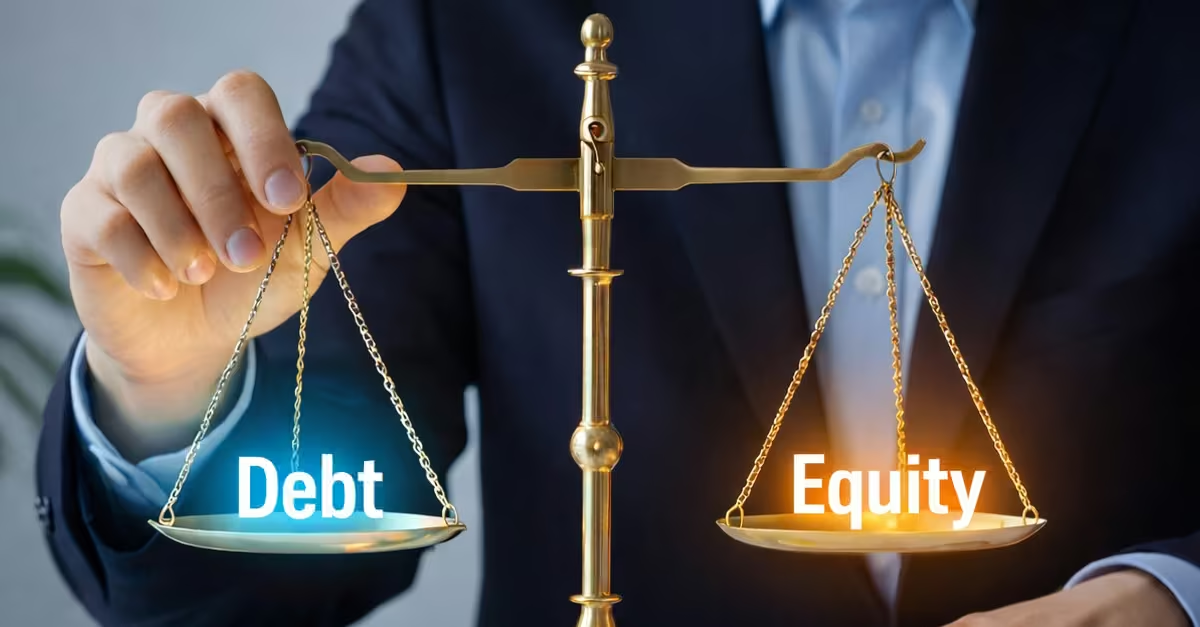
An optimal capital structure is the most efficient combination of equity and debt financing for a company to maximize value and minimize its cost of capital. Reaching this optimal mix requires careful planning and balance, taking into account the company’s risk tolerance, financial position, and long-term goals, as per Vishwanath (2025). The objective is to create a structure that captures the benefits of both debt and equity while reducing their potential disadvantages. By carefully managing this balance, a company can lower its overall financing costs and strengthen its long-term financial performance.
Finding Optimal Capital Structure
Determining the right mix of debt and equity for your business requires careful evaluation of both internal company characteristics and external economic conditions. Businesses must consider cost efficiency, risk exposure, and long-term growth objectives when designing their financing strategy. A study by JOM Accounting highlights the following factors that guide you when determining your optimal capital structure.
a. Cost of Capital
Weighted Average Cost of Capital is the method used to measure the cost of capital. It mainly represents the average return a company must provide to both lenders and shareholders. This method combines the cost of debt and the cost of equity based on their respective proportions in the company’s capital structure. In most entities, they aim to keep WACC as low as possible because a lower cost of capital increases company value and makes investments more profitable. For a firm to achieve a low weighted cost of capital (WACC), it must use Moderate debt in its capital structure due to tax benefits on interest payments, but excessive borrowing increases financial risk and may cause investors to demand higher returns; hence, a controlled amount of debt is encouraged to be used in a business.
b. Business Risk
Business risk refers to the unpredictability of a company’s operating income, driven by competition, changing customer demand, or operational challenges. Companies in high-risk industries, such as technology startups or highly competitive consumer markets, often avoid heavy borrowing because uncertain earnings can make debt repayment difficult. If your business operates in risky environments, your optimal capital structure should lean toward equity rather than debt.
c. Industry Norms
Industry norms influence financial decisions, as companies tend to follow capital structure patterns common to their sector. Therefore, when deciding how much equity or debt to use in your business, you must look at the optimal mix of debt and equity used by similar businesses in your Industry so you don’t stand out as unusually different.
For instance, utility companies typically carry a higher debt ratio than equity, as they have stable and predictable revenues, so if you are starting a business that operates in the utility industry, you are advised to use an optimal capital structure of more debt than equity.
d. Company Size and Growth Stage
The size and stage of development of a company strongly affect its financing choices. Large and well-established businesses generally have better access to debt markets because they possess stable cash flows, strong credit records, and assets that can serve as collateral, so their optimal structure can be more of debt than equity.
Smaller or early-stage companies often depend more on equity financing, since lenders view them as riskier borrowers and they dont have predictable, stable cash flows to service debt financing; thus, their optimal capital structure should be more equity than debt.
e. Market Conditions
External economic conditions, especially interest rates, play a key role in borrowing decisions. During periods of low interest rates, debt financing becomes more attractive because borrowing costs are lower. On the other hand, high interest rates make borrowing more expensive and may discourage companies from taking on additional debt. Thus, the optimal capital structure chosen should be adjusted to economic cycles, credit market conditions, and overall investor confidence.
f. Revenue Stability
Using debt to finance your operations will require your business to pay mandatory fixed interest payments. This will be suitable primarily if you are generating consistent, predictable revenue. Therefore, in this case, your optimal capital structure should be more of debt than equity.
On the other hand, if your business operates in seasonal, highly volatile markets, its revenue will not be stable, so it will face greater risk when using debt financing, as uncertain cash flows may lead to liquidity problems. In this case, you will be required to use more equity than debt in your capital structure.
g. Industry Risk
Different industries face different risks, which affect how much debt they can handle. For instance, capital-intensive industries with steady demand may support higher borrowing, hence their capital structure will entail more debt than equity. At the same time, sectors exposed to rapid technological change and strong market volatility often rely more on equity financing, so the capital structure here should entail more equity than debt.
Read Also: Shares Investment in Kenya: Everything You Need to Know
Common Mistakes to Avoid in Capital Structure Management
Managing capital structure requires careful financial judgment because poor financing decisions can affect long-term business sustainability. Understanding these common mistakes helps businesses maintain balanced leverage, protect cash flow stability, and support sustainable growth.
- Over-Leveraging with Debt
A business must use a manageable level of debt because excessive reliance on borrowed funds increases fixed repayment obligations and financial pressure on operating cash flow, which can lead to negative results for the business. Businesses are therefore advised to monitor leverage ratios to ensure borrowing remains within manageable and industry-appropriate levels.
- Ignorance of Market and Economic Signals
Your business’s financing decisions must reflect prevailing economic and financial market conditions. Rising interest rates increase borrowing costs, while falling rates may create favorable debt financing opportunities. Ignoring inflation trends, credit market availability, or investor sentiment can lead to costly financing mistakes.
- Poor Balance Between Risk and Control
When choosing between debt and equity financing, you must also consider the trade-off between financial risk and ownership control. Excessive debt increases bankruptcy risk, while excessive equity issuance can dilute ownership and strategic decision-making authority. Businesses must design capital structures that preserve both financial safety and managerial control.
- Failing to Review Capital Structure Periodically
Capital structure is an ongoing financial management process. Changes in business size, industry competition, interest rates, and revenue patterns may require adjustments to the financing strategy. Companies that fail to reassess their capital mix periodically may operate with outdated or inefficient financial structures.
Conclusion
Capital structure is the foundation of a business’s financial strategy, representing the mix of debt and equity used to finance operations and growth. Businesses can finance their operations mainly through two sources: equity or debt. Identifying the right proportion that minimizes the cost of capital while maximizing firm value is known as an optimal capital structure, which recognizes that moderate leverage can provide benefits. At the same time, excessive debt increases the risk of financial distress. For a business to make the right decisions in making optimal capital decisions, it must consider factors like the cost of borrowing, the business risk, and the cost of capital of other firms that are related in the same Industry, the business’s size and growth, the prevailing market conditions, and the stability of the earnings of the business. While making these decisions, many businesses make mistakes that can be easily avoided, including excessive debt use, ignoring economic signals, misjudging growth potential, and failing to review financing strategies regularly.