The finance world of today is changing very fast. Technology is no longer a tool; it influences how investors manage their money and financial decisions. Financial technology (fintech innovations) is changing how businesses and people handle their money. The financial strategies have been transformed due to fintech innovation, which has changed from traditional banking to mobile banking, AI-powered financial planning, and blockchain securities. These technological solutions have been improved; thus, businesses and customers need to adapt to the newly evolved financial tools. This article will dive into how fintech innovations are influencing financial strategies and their efficiency.
The Rise of Digital Payments And Mobile Banking
Instead of using cash and visiting physical banks, most companies and individuals have shifted to using technology to handle their money with the help of internet connection and mobile phones.
Digital Wallets
Digital wallets are mobile phone applications that digitally store companies’ and individuals’ debit and credit information. This has changed how people affect their transactions, as they are not required to carry physical cash to pay for goods and services; instead, they can do this using their mobile phones. A good example of the most common apps used in digital wallets, as per Simran (2025), are:
- PayPal– this is the most used digital wallet, which can store credit and debit card information. It can be linked to a bank account; thus, a lot of transactions can be done through it.
- Mpesa– this digital wallet was launched in 2007. It enables the user to send money locally and also internationally. It has features like pay bills and buy Goods, which helps to make payments. Additionally, it offers various banking products like loans.
- Amazon Pay is a digital wallet mainly used by Amazon users. The members’ payment information is stored in the digital wallet, which they use during payments and even when sending money.
- Google Play – This feature is mainly available to Android phone users. It gives users the ability to perform payments digitally and store the user’s payment information.
Wireless Transactions
Wireless transactions is a method of payment where people pay for goods and services with the help of technologies like QR codes and near-field communication. For instance, in businesses that use QR codes, the customer must scan the code, enter the amount of money to pay, and finally pay the money; hence, contactless transactions as you don’t need to touch physical cash. Additionally, when using near-field communication, the customer opens the digital wallet and moves the mobile phone closer to the transaction terminals. The terminal reads the payment information and processes the transaction.
Biometric Payment Verifications
Biometric verification is a way to confirm the user’s identity using a unique biological characteristic about his body, such as its face or fingerprint. It usually compares the users’ biometric data, which was previously stored, and the current entered to verify the identity. This method is a security feature to authenticate payments instead of users entering their identification PIN. A good example is the Mpesa App; you can authenticate the payment using your fingerprint instead of a personal identification pin. This innovation has improved security, efficiency, and accessibility to one’s funds compared to the traditional ways.
Smart Contracts for Automated Transactions
Smart contracts are computer programs stored in the blockchain that help execute the terms of the agreement automatically when the predefined conditions have been met. For instance, a contract states that “Non-fungible tokens (NFT) will be transferred to the buyer if he send 3 Ethereum (ETH).” in this case, when the buyer makes the agreed payment, the contract is automatically executed. In this method, no intermediaries or manual steps are involved. The method provides a secure way of doing cryptocurrency transactions as it is safe, transparent, and faster and an automated process.
How Smart Contracts Work
Below are the steps followed during smart contracts as per Erika (2024)
- The parties wanting to enter the contract agree on the smart contract’s conditions. In our case, “Non-fungible tokens (NFT) will be transferred to the buyer if he sends 3 Ethereum (ETH.)”
- The conditions are then written into code with the help of programming languages and stored in the blockchain.
- Smart contracts automatically execute the contract when the agreed-upon conditions have been triggered. For instance, in our case, when the buyer has sent the 3 ETH, the non-fungible tokens are automatically transferred to him.
- No person can change the conditions once executed because no intermediary is needed.
Artificial Intelligence and Automation In Financial Planning
AI-powered Personalization
Artificial intelligence has played an essential role in changing individuals’ financial strategies and planning by facilitating tailored financial services. Al can analyze large amounts of customers’ data, such as spending habits, income earned, financial targets, and risk-taking behaviors. By analyzing all the above transactional data, Al comes up with personalized financial advice, strategies a customer will use to save, and financial planning suggestions. This customization by AI has improved customer experience since it comes from their habits and behaviors, thus making better financial decisions and strategies.
Prediction of Market Trends
AI has been a vital tool in forecasting market trends, thus improving financial decisions and strategies. The ability of AI to analyze market data like previous price movements, customer sentimental metrics, and market indicators. Al models can detect the relationships and patterns that human data analysts can fail to identify. By analyzing the data, Al can predict how the market will behave. This will help investment institutions, financial advisors, and investors understand how the market environment will shift to modify their economic strategies.
Automated Customer Support and Chatbots

The ways financial institutions interact with their clients have improved recently due to the automated communications and customer support based on Al-powered chatbots. These chatbots can understand the customers’ questions and respond instantly using natural language processing. Sarah (2024) highlights that chatbots assist in tasks like guiding customers through digital platforms, managing the client’s account, and responding to policy questions. This helps reduce operations costs, errors and promotes efficiency as no customer service representative is involved. The chatbots enhance customer satisfaction and improve financial services processes as their services are always consistently available.
AI-driven Wealth Management and Robo-advisors
The evolution of wealth management automation has led to the development of Robot advisors. Robo-advisors are digital wealth advisors who can manage one’s investments automatically using technology and algorithms with fewer human interventions. The Robi advisors used the clients’ financial goals, risk-bearing capacity, and investment holding period to analyze and understand the client profile. After understanding the profile, it can help develop a personalized, diversified portfolio that matches the user’s profile.
AI uses preprogrammed protocols and guidelines to reinvest earnings, rebalance users’ assets, and execute trade automatically. This reduces human intervention, which may be prone to errors, emotions, and biases from the investment management, thus influencing one financial strategy.
Digital Credit Scoring System
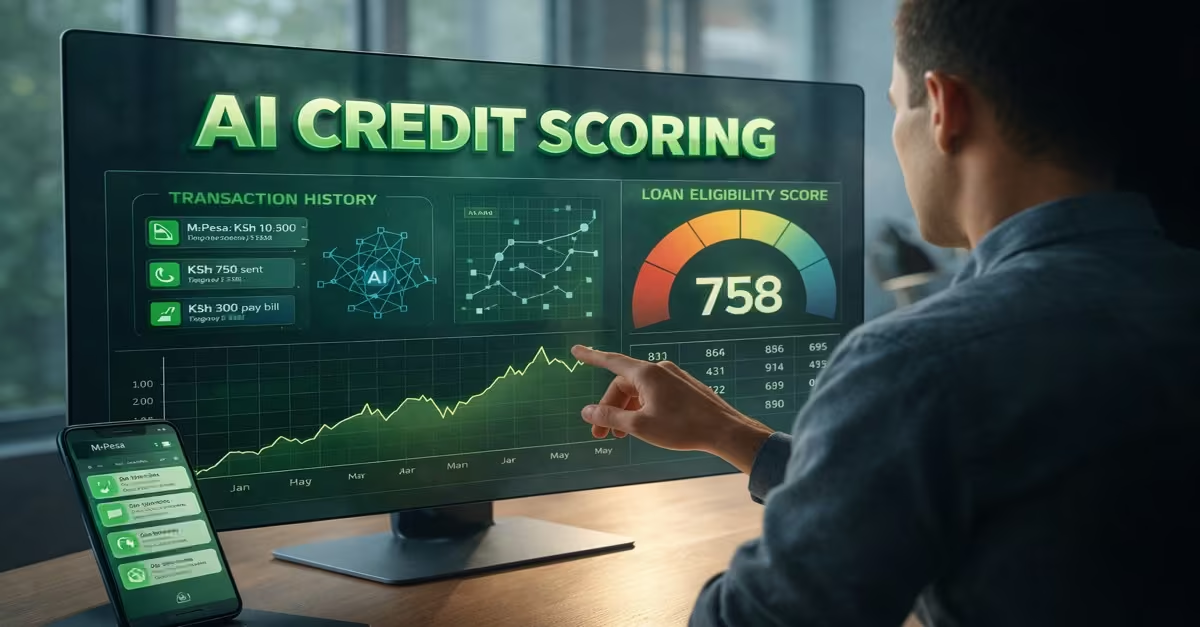
Before a financial institution gives a business or an individual a loan, it must examine its creditworthiness using the credit scoring system. This process has been transformed due to automated credit scoring with the help of AI. Financial institutions initially depended on traditional ways of analyzing the client’s data, which was time-consuming, and the data from the customer was limited in most cases.
Al-based credit scoring systems can analyze customer data, like transaction behaviors, purchase history, and online behavior. It then uses algorithms to identify the risk exposed to the particular customer, thus assigning a specific credit score. This process is done accurately and very first; therefore, one can acquire a loan faster. This method increases the number of loans given out to customers and improves customer satisfaction.
Personal Finance Applications
In our modern world, budget and expense-tracking apps have emerged. These applications can monitor the financial activities of the user with the use of machine learning algorithms. They analyze the financial activities to classify the users’ transactions and develop insights on how the user can spend the money wisely. These apps can also help users predict future expenditures by analyzing historical data. This has enabled many users to follow their budget goals and enhance how they manage their money.
Regulation Technology and Cyber Security Fintech
Al Fraud Monitoring Tools
Detecting fraud has been transformed with the help of the innovation of AI-based fraud detection systems. These systems can monitor suspicious activities like sign-in attempts from new devices, transactions from new locations, and abnormal spending patterns with the help of machine learning and pattern recognition. This helps financial institutions and fintech firms detect fraud easily.
End-to-end Encryptions in Financial Transactions

Fintech applications have adopted end-to-end encryptions to facilitate the confidentiality and integrity of financial data during transitions. In this method, on the senders’ side, the data is encrypted and then will only be decrypted by the intended person at the recipient side; there are no intermediaries needed, or even the service providers are being involved in this method thus ensuring there is no unauthorized access from hackers from. End-to-end encryptions are most used in mobile banking apps, peer-to-peer payments, and digital wallets.
Cyber Security Measures in Fintech
As technology evolves, most financial services are being done digitally. This has increased cyber security concerns as unauthorized people may access the customers’ data, necessitating the fintech firms to prioritize cyber security in their operations. Technological innovations like biometric authentications, two-factor authentication, and Quantum-safe encryption methods are used by the fintech to prevent cyber threats.
Regulatory Technology for Compliance
Regulation technologies refer to the technological innovations that enable an entity to adhere to the regulatory standards that will allow them to detect fraudulent financial activities and abnormal transactions among the users. Fintech companies use machine learning and AI to ensure that they comply with the above rules because they automate processes like knowing anti-money laundry, knowing your customers, and monitoring the users’ transactions, making it easy to detect when there is suspicious activity in the users’ accounts.
Conclusion
Financial technology is changing how business and individuals manage their money. Financial services have become more accessible, efficient, faster, and safe with the help of innovations like artificial intelligence, algorithms, machine learning, and automation. AI can easily offer personalized financial advice, help one modify spending habits, and make a budget, thus improving money management. Machine learning can help financial institutions detect fraud and comply with regulatory requirements. Automation can assist an individual and investment companies in executing trade and managing their portfolio on their behave, thus avoiding human intervention, which is prone to errors and emotions. Finance is becoming more digital as even financial institutions use AI to analyze customer data and assign credit scores to know the risk they are exposed to if they give a loan to a particular client. Thus, individuals and businesses must adapt to the above fintech innovations and make them essential in daily operations.