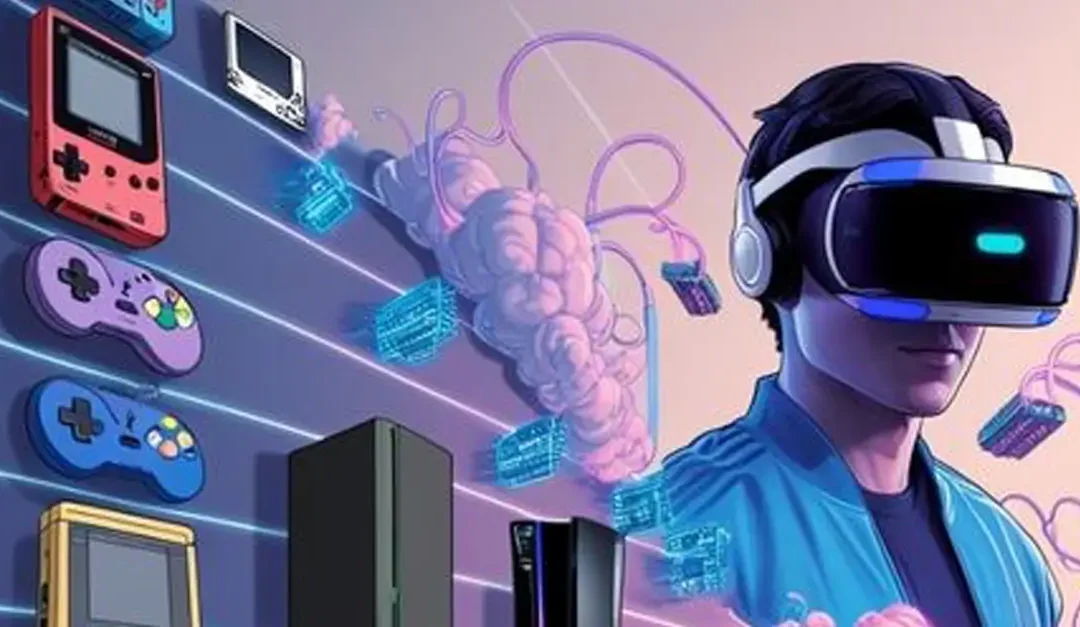
The evolution and future of gaming industry is forever changing considering it has undergone an extraordinary transformation over the past few decades. From humble beginnings with simple pixelated games, gaming has evolved into one of the largest entertainment industries globally. Today, it generates billions of dollars annually and has shaped popular culture, influencing everything from art and storytelling to social interactions and competitive sports. Video games are no longer a niche hobby for a select group of enthusiasts; they are a mainstream form of entertainment enjoyed by people of all ages, backgrounds, and walks of life. As technology continues to advance, the gaming industry is poised to enter new frontiers. This blog post explores the evolution and future of the gaming industry, its current state, and the exciting future that lies ahead, including innovations in virtual reality (VR), mobile gaming, and cloud-based platforms.
1. The Early Days: From Arcades to Home Consoles
The gaming industry’s history can be traced back to the 1970s with the advent of arcade games. Pioneering titles like Pong (1972) and Space Invaders (1978) offered simple yet addictive gameplay, marking the birth of video gaming as a form of entertainment. Arcades became social hubs where players gathered to challenge each other and compete for high scores. The graphics were simple—just blocks and dots—but the excitement of the games captured the imaginations of a generation.
The next major milestone came in the early 1980s with the introduction of home consoles. The Atari 2600, released in 1977, was one of the first to bring video gaming into the living room. It allowed players to enjoy games like Asteroids and Space Invaders at home. This marked the beginning of the transition from arcades to home gaming, making gaming more accessible to the masses. Soon, the Nintendo Entertainment System (NES) followed, introducing iconic games like Super Mario Bros., The Legend of Zelda, and Donkey Kong—titles that would go on to become pillars of the gaming industry.
The early days of gaming laid the foundation for everything that followed, and the simplicity of early titles remains an enduring part of gaming culture today.
2. The Rise of Personal Computers and Online Gaming
As personal computers became more accessible in the late 1980s and 1990s, gaming began to take on new dimensions. Early PC games like SimCity and Doom pushed the boundaries of what gaming could be. PCs allowed for more complex games with better graphics and deeper narratives. However, it was the rise of online gaming in the mid-1990s that truly revolutionized the industry.
The introduction of multiplayer games like Warcraft and Quake marked the beginning of the online gaming era. These games allowed players to connect over the internet, battling opponents across the globe in real-time. The concept of multiplayer online gaming took off with games like EverQuest and World of Warcraft, both of which introduced the idea of the massively multiplayer online role-playing game (MMORPG). These games provided vast virtual worlds for players to explore, and the social aspect of gaming became more pronounced. Guilds, communities, and even in-game economies began to form, turning gaming into a shared experience rather than a solitary pursuit.
The rise of broadband internet in the early 2000s made online gaming even more accessible, paving the way for a new wave of games and players. The ability to compete against players from across the world became a key aspect of gaming culture, and online gaming’s popularity continues to grow to this day.
3. 3D Graphics and the PlayStation Era: Revolutionizing Gameplay
The late 1990s and early 2000s saw a major shift in gaming technology with the advent of 3D graphics. This period marked a leap forward in both gameplay and visual fidelity. The release of the Sony PlayStation in 1994 was a game-changer. The console’s ability to render 3D graphics allowed developers to create more immersive and realistic game worlds. This shift brought about a new wave of gaming experiences, from Final Fantasy VII to Metal Gear Solid, games that defined a generation.
The PlayStation’s success also sparked a fierce competition among console manufacturers. Sega, Nintendo, and later Microsoft with the Xbox all entered the fray, each pushing technological boundaries in different ways. Sony’s PlayStation 2, released in 2000, became the best-selling video game console of all time, due in part to its advanced graphics and a massive library of exclusive games. The rise of 3D gaming also saw the introduction of fully realized game worlds, cinematic storytelling, and more intricate gameplay mechanics. Games like Grand Theft Auto III, Halo, and The Legend of Zelda: Ocarina of Time became not only critical and commercial successes but cultural touchstones that influenced future generations of developers and gamers alike.
The PlayStation era also ushered in the concept of online gaming for consoles. The introduction of the PlayStation Network and Xbox Live allowed players to compete, communicate, and collaborate across long distances, shaping the future of multiplayer gaming.
4. Mobile Gaming: A New Era of Accessibility
The introduction of smartphones marked the beginning of a new era for gaming. In the early 2000s, mobile gaming was limited to basic games like Snake on Nokia phones. However, with the launch of the iPhone in 2007 and the App Store in 2008, mobile gaming exploded. Games like Angry Birds, Candy Crush, and Clash of Clans reached millions of players around the world, and mobile gaming became a dominant force in the industry.
Mobile games are typically more accessible and affordable than console or PC games. Free-to-play games, supported by in-app purchases, have become the dominant business model in the mobile gaming market. This shift has allowed for the development of games that are easy to pick up and play, with short play sessions that are perfect for on-the-go gaming. Mobile gaming’s accessibility has also democratized gaming, bringing it to a broader audience, including casual gamers who may not have been interested in more traditional forms of gaming.
The rise of mobile gaming has led to the development of some of the most successful games in the world, and it continues to shape the future of the gaming industry. With the advent of cloud gaming, mobile devices are becoming even more powerful, capable of handling console-quality games on the go.
5. Virtual Reality (VR) and Augmented Reality (AR): The Next Frontier
Virtual Reality (VR) and Augmented Reality (AR) technologies have opened up new dimensions for gaming. VR immerses players in completely digital worlds, allowing them to interact with game environments in ways that were previously impossible. Early VR experiments in the 1990s were unsuccessful due to technological limitations, but recent advancements have brought VR gaming into the mainstream.
The Oculus Rift, PlayStation VR, and HTC Vive have made VR more accessible to gamers, providing hardware that can deliver immersive, interactive experiences. VR games like Beat Saber and Half-Life: Alyx have garnered critical acclaim for their ability to deliver truly unique gameplay experiences. These games allow players to physically move through game environments, creating a sense of presence that is unmatched by traditional gaming.
Augmented Reality (AR) takes a different approach by blending digital elements with the real world. Games like Pokémon Go have shown how AR can encourage physical activity and interaction with the environment. As AR technology continues to improve, it’s likely that more games will incorporate AR elements, offering new ways to experience gaming beyond the screen.
The future of gaming is likely to be shaped by both VR and AR technologies, with more immersive and interactive experiences on the horizon.

6. Esports: The Competitive Gaming Revolution
Esports has become a massive global phenomenon, with professional players, teams, and tournaments attracting millions of viewers. What started as a niche hobby has evolved into a multi-billion-dollar industry, with games like League of Legends, Dota 2, and Counter-Strike: Global Offensive leading the charge. Esports tournaments fill stadiums, and streaming platforms like Twitch and YouTube Gaming allow fans to watch their favorite players and teams in real-time.
Esports has given rise to professional gaming leagues, with players earning salaries, sponsorships, and prize money. The growing popularity of esports has led to its inclusion in major events like the Asian Games, with discussions about its potential inclusion in the Olympics. The competitive nature of esports has helped to establish gaming as a legitimate form of sports entertainment, offering viewers an engaging experience similar to traditional sports.
Esports also offers career opportunities for players, coaches, analysts, and content creators, creating a whole ecosystem around competitive gaming.
7. The Future of Gaming: AI, Cloud Gaming, and Streaming
As the gaming industry looks to the future, several technologies are poised to revolutionize the way games are developed and played. Artificial Intelligence (AI) is already shaping gameplay experiences, from the behavior of non-playable characters (NPCs) to the procedural generation of game worlds. AI will continue to play an important role in making games more immersive and dynamic, with developers using it to create intelligent enemies and responsive, evolving game environments.
Cloud gaming and game streaming are also set to change the landscape. Platforms like Google Stadia and Xbox Cloud Gaming allow players to stream games directly to their devices, bypassing the need for expensive hardware. This could make gaming more accessible, as players can enjoy high-quality games on devices like smartphones, tablets, and low-cost PCs. The transition from physical media to cloud-based gaming could also lead to a more sustainable and cost-effective model for the industry.
The rise of cross-platform play, which allows players on different consoles and platforms to play together, is another exciting development. This move toward more inclusive and connected gaming communities is expected to continue as cloud gaming and streaming platforms become more popular.
Conclusion
The evolution and future of the gaming industry has come a long way since its inception in the 1970s. From arcade cabinets to immersive virtual reality experiences, gaming has continually evolved, driven by technological advancements and changing consumer tastes. As the industry continues to grow and diversify, we can expect even more exciting innovations in the coming years, from AI-powered games to cloud gaming and esports.
Gaming is no longer just an entertainment medium; it’s a cultural force, influencing everything from social dynamics to global economies. As the future of gaming unfolds, players, developers, and fans alike will continue to shape the industry into something even more spectacular.
Further Reading: