
University examinations can be stressful, especially when students have several units to revise, assignments to complete, and limited time before exams begin. For many Kenyan university students, commonly known as comrades, examination season brings sleepless nights, packed libraries, endless revision notes, and pressure to achieve good grades. Whether you study at the University of Nairobi, Kenyatta University, JKUAT, Moi University, Egerton University, Maseno University, or another institution, preparing effectively for examinations requires more than reading notes repeatedly.
Many students spend hours studying but struggle to remember information during examinations. Others wait until the last week before opening their books, hoping to cover an entire semester’s content within a few days.
Fortunately, research on learning and memory has identified several techniques that can improve understanding, retention, and examination preparation.
- 10 Proven Study Techniques
- 1. Create a Realistic Revision Timetable
- 2. Use Active Recall Instead of Passive Reading
- 3. Practise Using Previous Examination Papers
- 4. Apply Spaced Repetition to Remember More
- 5. Use the Pomodoro Technique to Manage Study Time
- 6. Join Productive Group Discussions
- 7. Manage Examination Anxiety and Stress
- 8. Prioritize Difficult Topics and Understand the Course Outline
- 9. Use Technology and AI Tools Responsibly
- 10. Get Enough Sleep and Prepare Before Exam Day
- Common Mistakes Kenyan University Students Make During Exam Preparation
- Frequently Asked Questions About University Exam Preparation
- Conclusion
10 Proven Study Techniques
This guide explores 10 effective study techniques for Kenyan university students, including revision timetables, past papers, active recall, time management, and practical ways to manage examination anxiety.
1. Create a Realistic Revision Timetable
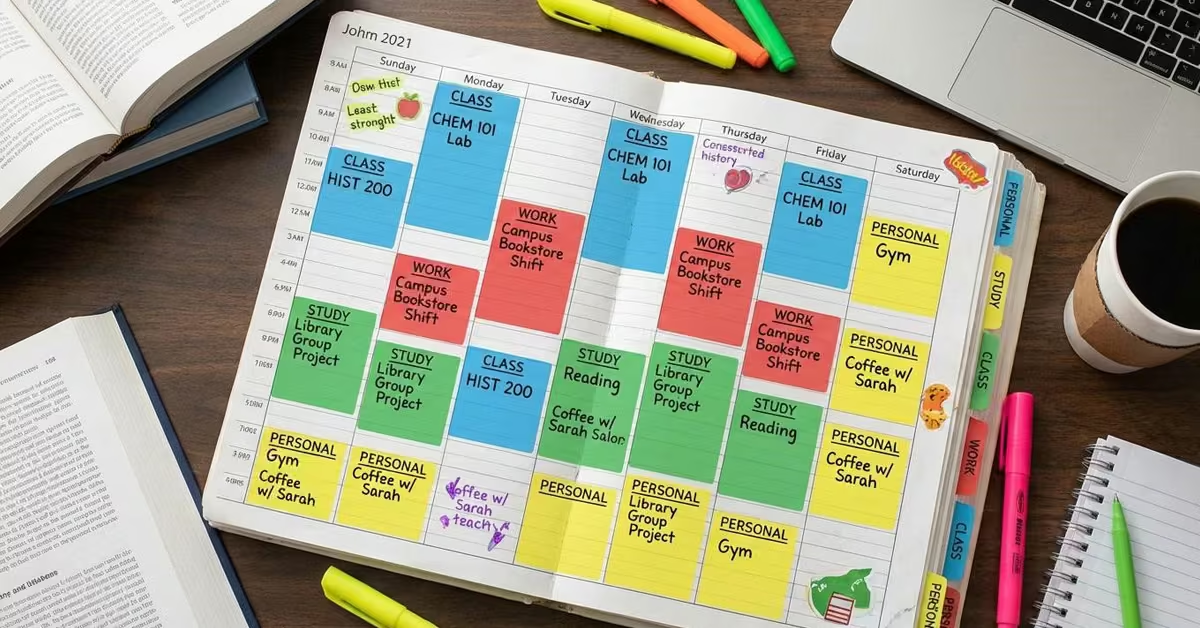
One of the biggest mistakes university students make is starting revision without a clear plan.
A revision timetable helps you organize your study sessions, identify difficult units, and allocate enough time to different subjects.
Start by listing all the units you are taking during the semester. Next, identify the examination dates and determine how much time remains before each paper.
Allocate more revision time to difficult units while maintaining regular practice in subjects you already understand.
For example, a student taking six units could use the following timetable:
| Day | Revision activity |
| Monday | Mathematics and Statistics |
| Tuesday | Communication Skills and ICT |
| Wednesday | Research Methods and Economics |
| Thursday | Mathematics and Statistics practice |
| Friday | Review difficult topics |
| Saturday | Attempt past examination papers |
| Sunday | Light revision and rest |
Your timetable should reflect your actual course units and examination schedule.
Avoid creating unrealistic plans that require studying continuously for twelve hours. Include breaks, meals, sufficient sleep, and time for other responsibilities.
A manageable timetable followed consistently is more useful than an ambitious schedule abandoned after two days.
Read Also: How to Apply for HELB Subsequent Loan 2026/2027
2. Use Active Recall Instead of Passive Reading
Active recall is a learning technique that involves retrieving information from memory without looking at your notes. Many students believe that repeatedly reading lecture notes is enough to prepare for examinations. However, recognizing information while reading does not necessarily mean you can reproduce it during an exam.
Active recall encourages you to test what you actually remember.
After studying a topic, close your notebook and attempt to explain the main ideas without checking your notes.
For example, if you are studying computer networks, ask yourself:
- What is a computer network?
- What are the differences between LAN, MAN, and WAN?
- What are the advantages of network topologies?
- How does the OSI model work?
Write your answers from memory before comparing them with your lecture notes.
Research by Roediger and Karpicke (2006) demonstrated that retrieval practice can improve long-term retention compared with repeated studying.
Students can learn more about retrieval-based learning through The Learning Scientists’ retrieval practice resources.
3. Practise Using Previous Examination Papers

Past examination papers are among the most useful revision resources available to university students.
They help students understand examination formats, question structures, commonly assessed concepts, and the amount of detail expected in answers.
Many Kenyan universities provide previous examination papers through institutional libraries, departmental repositories, or approved student learning platforms.
For example, students can explore the University of Nairobi Digital Repository for academic resources.
However, the availability of past papers varies between institutions and departments.
When using past papers, avoid simply memorizing previous answers. Instead, identify the underlying concepts and practise applying your knowledge to different questions.
Set a timer and attempt an entire paper under examination conditions.
After completing it, review your answers against lecture notes, marking guidelines, or lecturer feedback where available.
Past papers help you prepare for the examination format, but they cannot guarantee which questions will appear.
4. Apply Spaced Repetition to Remember More
Spaced repetition involves reviewing information at increasing intervals rather than concentrating all revision into one session.
For example, instead of studying a topic for five hours on one evening and forgetting about it, you could revise it several times over two weeks.
A simple revision schedule might involve reviewing material:
- On the day you first study it
- One day later
- Three days later
- One week later
- Two weeks later
These intervals are examples, not fixed requirements. Adjust them depending on the difficulty of the material and how well you remember it.
Spaced repetition is especially useful for subjects involving definitions, formulas, scientific terminology, and technical concepts.
Students can create digital flashcards using Anki or ordinary handwritten cards.
The important principle is to revisit information before it becomes completely unfamiliar.
Research by Cepeda et al. (2006) found that distributed practice generally improves retention compared with concentrating the same learning into fewer sessions.
5. Use the Pomodoro Technique to Manage Study Time
The Pomodoro Technique is a time-management method that divides work into focused sessions separated by short breaks.
A common approach involves studying for 25 minutes, taking a five-minute break, and repeating the cycle.
After four sessions, take a longer break of approximately 15–30 minutes.
For example, a student revising accounting could spend the first session reviewing financial statements, the second solving calculations, and the third checking mistakes.
This structure may help students who struggle with distractions or feel overwhelmed by large amounts of work.
During each study session, silence unnecessary phone notifications and avoid switching between social media and revision materials.
You can use a phone timer or an online tool such as Pomofocus.
Although the Pomodoro Technique is popular, the exact 25-minute interval is not scientifically established as ideal for everyone. Experiment with longer or shorter sessions depending on your concentration and workload.
6. Join Productive Group Discussions

Group discussions are a familiar part of campus life in Kenya, especially during examination periods.
When organized properly, group revision allows students to exchange ideas, clarify difficult concepts, and learn from different explanations.
For example, students preparing for a programming examination could discuss algorithms, compare solutions, and explain code to one another.
Teaching a concept to another student can also reveal gaps in your own understanding.
However, group discussions become ineffective when members spend most of their time gossiping, scrolling through social media, or discussing unrelated matters.
To make group revision productive, select a specific topic, assign questions to members, and establish a time limit.
Encourage everyone to participate rather than allowing one student to explain everything.
Use group discussions to complement individual study, not replace it.
Read Also: TikTok Marketing in Kenya: How Businesses Can Grow Online
7. Manage Examination Anxiety and Stress
Examination anxiety affects students differently. Some experience nervousness, difficulty concentrating, racing thoughts, or physical symptoms such as sweating and stomach discomfort.
A certain level of nervousness before an examination is common. However, excessive anxiety can interfere with studying and performance.
One way to reduce examination stress is to prepare early rather than depending entirely on last-minute revision.
Practising past papers under timed conditions can also make the examination environment feel more familiar.
Other helpful strategies include maintaining regular sleep schedules, taking short breaks, exercising, and practising slow breathing when feeling overwhelmed.
Avoid excessive caffeine consumption or staying awake throughout the night before an examination.
Students experiencing persistent or severe anxiety should consider speaking with a university counsellor or qualified healthcare professional.
The World Health Organization’s stress guidance provides additional information about recognizing and managing stress.
8. Prioritize Difficult Topics and Understand the Course Outline
Not every topic requires the same amount of revision time.
Some students spend too much time reviewing familiar material because it feels easier and more comfortable.
However, effective preparation requires identifying areas where your understanding is weak.
Begin by reviewing the course outline, lecture objectives, and topics covered throughout the semester.
Create three categories: topics you understand well, topics requiring additional practice, and topics you find particularly difficult.
Allocate more time to the difficult areas while continuing to review the others.
For example, a computer science student might understand computer hardware but struggle with database normalization.
Rather than repeatedly reviewing hardware definitions, the student should dedicate additional sessions to practising normalization problems.
When necessary, seek clarification from lecturers, teaching assistants, classmates, or approved academic resources.
Understanding the entire syllabus is generally safer than concentrating exclusively on topics you believe will appear in the examination.
9. Use Technology and AI Tools Responsibly

Technology can make examination preparation more organized and interactive.
Students can use digital flashcards, online tutorials, educational videos, note-taking applications, and artificial intelligence tools to support learning.
For example, AI tools can help generate practice questions, explain difficult concepts in simpler language, or suggest revision schedules.
Useful learning resources include Khan Academy, Google Scholar, and YouTube educational channels.
However, AI-generated answers are not always accurate.
Students should verify important information against lecture notes, textbooks, and credible academic sources.
Avoid submitting AI-generated material as your own work when doing so violates university academic integrity policies.
The goal should be to use technology to strengthen understanding rather than avoid the learning process.
Read Also: The Emerging Internet: Benefits and Adoption
10. Get Enough Sleep and Prepare Before Exam Day
Sleep is an important part of learning because it supports memory consolidation, concentration, and cognitive functioning.
Unfortunately, some university students sacrifice sleep during examination periods, believing that studying throughout the night guarantees better results.
In reality, severe sleep deprivation can make it harder to concentrate, remember information, and solve problems.
Most adults need approximately seven to nine hours of sleep per night, although individual requirements vary.
Students should also prepare examination materials in advance, including identification documents, pens, calculators where permitted, and any other required items.
Confirm the examination venue, reporting time, and applicable regulations.
On examination day, arrive early enough to settle comfortably and avoid unnecessary panic.
Read instructions carefully, allocate time according to the marks available, and answer questions systematically.
If you encounter a difficult question, move to another question when appropriate and return later.
Common Mistakes Kenyan University Students Make During Exam Preparation
Despite spending considerable time studying, students sometimes adopt habits that reduce the effectiveness of their revision.
Common mistakes include:
Studying for university exams is quite different from high school; the volume of material is vastly larger, and university professors usually test for conceptual synthesis and application rather than rote memorization.
The most common mistakes university students make when preparing for exams and how to fix them—include:
1. Relying Solely on Passive Learning
Re-reading lecture slides, highlighting textbooks, or watching endless video lectures over and over. This creates the “illusion of competence”—because the text looks familiar, you assume you know it. Shift to active recall. Close your notes and try to write down everything you remember (the Feynman Technique), use flashcards (Anki), or explain concepts out loud as if teaching someone else.
2. Cramming and Procrastinating
Leaving preparation until a few days before the exam and attempting to absorb an entire semester’s worth of content in 48 hours. This overloads working memory and leads to high stress and poor retention. Instead, use spaced repetition. Spread your studying across weeks, revisiting topics at increasing intervals (e.g., day 1, day 3, day 7) to move information into your long-term memory.
3. Ignoring Past Papers and Mark Schemes
Treating textbooks as the only source of truth while completely ignoring past exam papers or professor sample questions. Students should practice with past papers under timed conditions early in your prep. University exams often have specific formatting, recurring core themes, and strict grading rubrics that you need to get used to navigating.
4. “Comfort Studying” (Avoiding Hard Topics)
Spending 80% of your study time on topics you already understand because it feels satisfying, while running away from complex, mathematically heavy, or conceptually confusing modules. One should prioritize your weakest areas first when your energy levels are highest. Use a “doubt log” to track concepts you don’t understand and consult professors, teaching assistants, or study groups to clear them up.
5. Collecting Too Many Resources
Downloading dozens of extra PDFs, buying multiple textbooks, and hopping across conflicting online tutorials. This leads to analysis paralysis. Stick to your core curriculum: lecture notes, assigned readings, and lecture recordings. Use outside sources only to clarify a specific sticky concept, not to relearn the whole course.
6. Sacrificing Sleep and Health for “More Hours”
Pulling all-nighters right before the exam, running on caffeine, and cutting out exercise or social breaks under the assumption that more hours at the desk equals a better grade. Sleep is when your brain consolidates short-term memories into long-term storage. Chronic sleep deprivation severely tanks your problem-solving abilities and working memory right when you need them most. Aim for 7–8 hours, especially during exam week.
Generally, waiting until the last minute, relying entirely on photocopied notes, memorizing answers without understanding concepts, ignoring difficult units, and spending excessive time on social media.
Also, depending on rumours about leaked examination papers. Such materials may be fraudulent, inaccurate, or obtained through academic misconduct. Students should rely on legitimate academic resources and follow their institution’s examination regulations.
Effective preparation involves understanding concepts, practising questions, reviewing mistakes, and maintaining a balanced study routine.
Frequently Asked Questions About University Exam Preparation
How Many Hours Should A University Student Study Daily?
There is no universal number. Study time depends on course difficulty, examination proximity, personal responsibilities, and concentration. Consistent, focused revision is more important than simply counting hours.
Is Studying Overnight Before An Exam Effective?
Last-minute revision may help refresh familiar concepts, but replacing sleep with an all-night study session can impair concentration and memory.
Are Past Papers Enough To Pass University Examinations?
No. Past papers are valuable practice resources, but students should also study lecture notes, textbooks, course objectives, and other recommended materials.
What Should I Do If I Cannot Remember What I Study?
Try active recall, spaced repetition, practice questions, and explaining concepts without looking at your notes. If difficulties persist, seek academic support.
When Should I Start Preparing For University Exams?
Ideally, preparation should begin during the semester through regular review. More structured revision can begin several weeks before examinations, depending on the workload.
Conclusion
Preparing for university examinations in Kenya does not have to involve endless sleepless nights, panic, or memorizing hundreds of pages at the last minute.
Students can improve their preparation by creating realistic revision timetables, practising active recall, using past papers, applying spaced repetition, and managing study time effectively.
Group discussions, responsible use of technology, adequate sleep, and stress management also contribute to a healthier examination experience.
For Kenyan comrades, the most important lesson is that academic success depends not only on how long you study but also on how effectively you use your study time.
Start early, identify your weaknesses, practise consistently, and focus on understanding rather than memorization alone.
With the right preparation strategies, university students can approach examinations with greater confidence and build learning habits that remain useful beyond campus.