Introduction
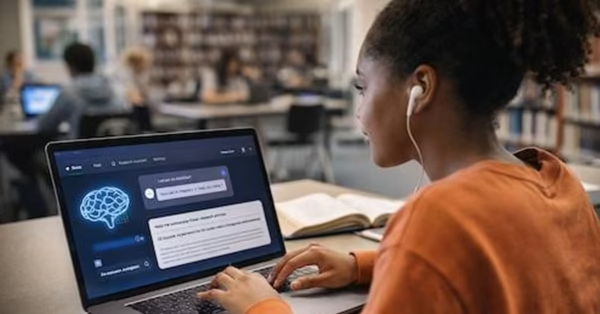
The education matrix refers to the complex network of factors that influence the quality of education. These variables include student-teacher ratios, access to resources, curriculum design, and assessment methods. While this matrix is multi-faceted, technology has the ability to address many of its shortcomings. Here, we address how solving the education matrix using technology is beneficial in the overall improvement of the quality and standards of any education system. Technology in education can help by providing:
A. Personalized Learning
One of the main advantages of technology in education is its ability to provide personalized learning experiences. An educator can use technology to easily assess the strengths and weaknesses of individual students and tailor their approach accordingly. This can be achieved through educational software and interactive learning platforms. By personalizing the learning process, technology can boost student engagement and facilitate higher levels of understanding.
B. Increased Access
Technology has also helped to address issues of access in education. By providing online courses, students can access education from remote locations with limited resources. This has greatly expanded the reach of education and has helped to ensure that students from all backgrounds have equal opportunities to learn. In addition, access to educational resources has increased through digital libraries and online archives.
C. Automated Assessment
Assessing student progress is a integral part of the educational matrix. However, traditional forms of assessment can be time-consuming and subjective. Technology has helped streamline this process through automated assessment tools. These tools provide instant feedback, allowing teachers to quickly identify areas where students are struggling and adjust their approaches. In addition, automated assessment has minimized biases in grading and reduced the likelihood of human error. technology has potentially solved many of the issues associated with the education matrix. By facilitating personalized learning experiences, increasing access, and streamlining assessment, technology has helped ensure that all students have access to quality education.
However, it is important to note that technology is not a panacea and cannot address all issues associated with the education matrix. As a result, it is essential that technology is used in conjunction with other educational approaches to create a comprehensive and holistic learning environment. in addition to addressing the shortcomings of the education matrix, technology provides additional benefits to both students and educators.
D. Enhanced Collaboration
Technology has allowed for an enhanced collaboration between students and teachers. Through online discussion forums and collaborative software, students can work together on projects and assignments regardless of their physical location. This not only encourages teamwork but also helps to develop important communication skills.

E. Improved Efficiency
Technology has helped improve the efficiency of educational processes. For example, through the use of digital textbooks, educators can update course materials in real-time without having to reprint physical copies. This saves time and resources while ensuring that students have access to up-to-date information. Additionally, one soft copy of a material can be distributed and be easily accessible to all students at once or anywhere they are without needing to get physical access to the source material in hard copy.
F. Innovative Teaching Methods
Technology has opened up new possibilities for teaching methods that were previously impossible or impractical. For example, virtual reality simulations can provide hands-on learning experiences that would be difficult to replicate in a traditional classroom setting. This type of innovative teaching method can greatly enhance student engagement and understanding. With augmented reality; the interactive experience that combines the real world and computer-generated content, it can provide a user with a heightened, more immersive experience than they would experience otherwise that adds to the user’s enjoyment or understanding of subject matter.
Read Also: Benefits of Technology in Research and Science Breakthroughs
Potential Drawbacks of Technology in Education
While technology has many benefits in education, it is important to also consider potential drawbacks.
A. Digital Distractions
One of the main concerns with technology in the classroom is the potential for digital distractions. With access to smartphones and other devices, students may be more tempted to check social media or browse the Internet during class time. This can negatively impact their learning experience and distract others around them.
B. Over-Reliance on Technology
Another potential drawback is an over-reliance on technology. While technology can enhance learning experiences, it should not replace traditional teaching methods entirely. Students still need face-to-face interaction with educators and peers to develop important social and emotional skills.
C. Cyber-Security Risks
Finally, there are cyber-security risks associated with using technology in education. Online platforms and digital resources may be vulnerable to cyber attacks or data breaches, which can compromise sensitive information about students and educators alike. It is essential that proper security measures are in place to protect against these risks.
Potential Solutions to Address Drawbacks of Technology in Education
While acknowledging the potential drawbacks of technology in education, there are several solutions that can be implemented to address these concerns.
A. Digital Citizenship Education
To combat digital distractions and promote responsible use of technology, educators can provide digital citizenship education. This includes teaching students about appropriate online behavior and how to stay focused during class time. By instilling good habits early on, students can learn to use technology in a responsible and productive manner.
B. Balancing Technology with Traditional Teaching Methods
To avoid over-reliance on technology, educators should aim to strike a balance between using technology and traditional teaching methods. For example, they can incorporate group discussions and hands-on activities into lessons alongside digital resources. This helps to ensure that students receive a well-rounded education that incorporates both technological and interpersonal skills.
C. Robust Cyber-security Measures
To mitigate cyber-security risks, educational institutions must implement robust security measures such as firewalls, encryption protocols, and regular data backups. In addition, educators should teach students about safe online practices such as creating strong passwords and avoiding suspicious links or emails. By prioritizing cyber-security, schools can protect sensitive information from cyber threats.